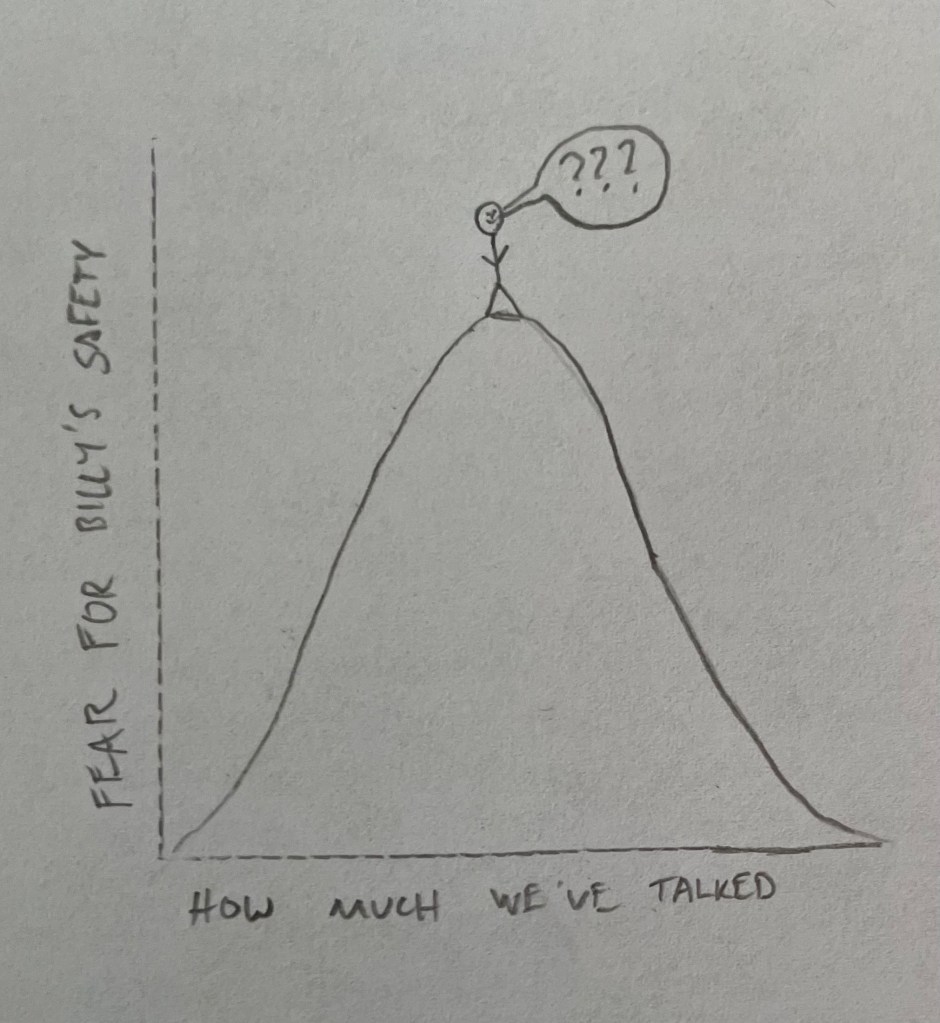
It’s been a repeatable, predictable, yet unique experience when I have the opportunity to describe my plans for 2021 to someone with fresh ears. Across the board, there’s a common response of encouragement and excitement, but I’ve been struck in noticing that the accompanying level of concern and trepidation forms a bell curve.
Unfortunately, if you’re reading this, and we haven’t sat down and discussed exactly why I won’t be starting a “thru-hike” attempt with any toilet paper, there’s a good chance you’ll find yourself near the peak of that bell. Here’s hoping this post helps you slide down the right half of the curve, even if just a little.
What are your plans for 2021?
Beginning in late February, I’ll begin an attempt to hike the entire ~2,190 miles of the Appalachian National Scenic Trail, beginning with the A.T. Approach Trail in Amicalola Falls State Park (Dawsonville, Georgia), and ending on Mount Katahdin in Baxter State Park (Northeast Piscataquis, Maine). The trail spans 14 states (Georgia, North Carolina, Tennessee, Virginia, West Virginia, Maryland, Pennsylvania, New Jersey, New York, Connecticut, Massachusetts, Vermont, New Hampshire, and Maine), and passes through eight National Forests and six units of the National Park system. The idea for the trail came from a forester by the name of Benton MacKaye in the 1920s, and the first validated hike of the trail in its entirety in a single season was Earl Shaffer in 1948.
Let’s talk about lingo for a moment. You can get knees deep in jargon in the sport (activity? hobby? lifestyle?) of long-distance backpacking, but the aim of this blog is not to get too technical – I just want to chronicle my thoughts and share them with you. That said, the term “thru-hike” is unavoidable, and it would do good to spend a little time talking about what exactly that means. The Appalachian Trail Conservancy defines a thru-hike as “completing the entire 2,190 miles of the Appalachian Trail (A.T.) in one trip”. I can’t speak to the etymology of the first half of the phrase, but it’s a homonym (or maybe slang – the two words do appear quite close in meaning so far as I can tell) of “through”. It’s important to note, however, that completing the trail in one trip does not mean spending every night on the trail. Because it is one of the oldest established long-trails, the A.T. passes through or near many towns and even metropolitan areas along its path, and it’s commonplace to go into town to purchase supplies, check mail (more on this later), catch a movie, and even stay for a night (or two) in a hotel, hostel, or a willing friend’s house. I know I quoted the ATC’s definition of a thru-hike above, and while they are a solid authority on all things A.T., depending on who you ask, you can get many different responses to the question “so what exactly is a thru-hike”? I don’t take a stance that any one response to this question inherently has more validity than any other response, because at the end of the day, I’m not attempting this hike to measure against a yard stick that any external source has devised. My plan will be to hike every mile of the A.T. during 2021, and I’ll plan to venture into towns and cities along the way.
This brings us to another fundamental mantra of those attempting a thru-hike – Hike Your Own Hike (HYOH). Every person who attempts to hike the A.T. is doing so for their own reasons (even if many folks share pieces of what drives them to go for it), and there is no “right way” to go about the journey. Nothing about this blog is intended to direct someone how they should or should not do something. It’s a glimpse into how I’m choosing to do something, and the way I’m thinking about that something.
I’d be remiss if I didn’t tell you a bit about the rest of my family’s plans for 2021. Glori is currently living with her parents, where I’ve also been this month and next (shoutout Manatee County). She’ll be based down here for the entirety of my thru-hike attempt, being a boss and continuing the decade long process of rearing Peterson (dog, not child). We’ve made some plans for her to visit along the way, since neither of us could stand to be apart for this long.
So let’s do some quick math: I’ll have 182 days to complete this attempt, so I’ll need to average ~11.5 miles per day. This may or may not seem like a lot, depending on your experience with hiking. This does not mean I’ll plan to hike 11.5 miles every day for 182 days. I’ll be planning to take rest days when I need them (little or no hiking), and there will be “monster” days, where my mileage may be well beyond that benchmark. I’ve roughly plotted out where I’ll need to be at a given point in time in the trip to stick to that average pace, and will use these guidelines to measure if I’m ahead or behind my plan. Aside from that, I don’t intend to plan out my mileage in advance. There will be sights worth stopping for, days where I’ll just want to tough it out, and side trips to visit friends in close proximity to the trail. For the first few weeks, I’ll be aiming for 10 mile days, until I get a better sense for what my body needs and can handle, both from exertion and caloric intake standpoints.
You must be doing a lot of training to get ready for something like that!
Less than you’re imagining. The best comparison I’ve heard when it comes to physically preparing for a long-distance hike is that hiking becomes your full-time job once you’re on the trail. Well, unfortunately, I’ve already got a full-time job, and while they’ve been incredibly supportive throughout the planning process, I can’t imagine they’d take too kindly to a request for additional time off to practice hiking all day. For that reason, the first few weeks will be quite a bit like starting a new job – you spend most of your time trying to figure out what in the world you’re doing. Don’t get me wrong, I’m in decent cardiovascular shape, and am not worried about the miles I plan to log the first few weeks, but I have no pretense that I’ll be prepared when I start the trail to hike the type of days that I hope will become commonplace as my body and mind adjust from the on-the-job training.
You mention a full-time job – that doesn’t seem to mesh well with what you’ve described thus far.
Astute observation, friend. Due to the ongoing impact of the COVID-19 pandemic, the sabbatical program at my employer was enhanced to offer up to six months leave. Thanks to the support of my team and some not insignificant sacrifices by my loved ones, I am able to attempt this journey and will return to work in the Fall of 2021.
Gosh, your backpack must weigh a ton for a trip that long!
Broken down, the Appalachian Trail is mostly a series of three to four day hikes stacked upon one another. As such, at any given time, I’ll really only be carrying the supplies I need to get me through the next three to four day segment. Water is plentiful on the A.T., so I will only have 2.5L of carrying capacity to get from one water source to the next (and 0.5L aren’t intended for drinking, but that’s for another post). Even so, food and water will be the bulk of the weight that I’ll be carrying from one resupply stop to the next. You see, there are two primary schools of thought that I heavily ascribe to when it comes to the style of backpacking that I enjoy: ultralight and Leave No Trace, which when executed properly, compliment each other quite well.
I won’t claim to be the first to describe the style of ultralight backpacking in this way, but I think about it is as follows: take the least amount of things you need and know exactly how to use in as many ways as are useful. It’s a pretty simple mindset by design, but it leads to some very complex and specific pieces of gear. For those of you that know me well, you know I could spend hours talking about gear selection. I’ve spent countless hours researching, trying (and erroring), and honing down the specific items that I plan to take on my thru-hike attempt. I’m very happy with the results, but that doesn’t mean what I plan to take is or should be a guide for anyone’s next camping trip – it all works well for me, and I know how to use it in a wide variety of circumstances and situations.
There is a library’s worth of information detailing the importance of Leave No Trace principles, and the goal of this post is not to add volumes to that library. The tragedy of the commons is tragic indeed, and at times, I lament over the impact that my presence will have on nature, irrespective of the amount of trash I pick up or the number of campfires I forego. It’s a difficult ideology to wrestle with, because humans in nature disrupt nature without humans – you may disagree with the right way to tackle that problem, but you will not convince me that minimizing my personal impact does not positively affect that problem.
Will I be able to contact you?
My communication set up will include a cell phone and handheld GPS. In 2021, the A.T. is pretty well-equipped from a service perspective, however, during most days, I will not have the signal enabled in order to preserve the cell phone battery for its many other uses (music, camera, navigation, journal, book, etc.). Glori will know my whereabouts in real-time. If you’d like to get in touch, you can either reach out digitally (billy@billygoeshiking.com), or send me snail mail. There are many locations along the A.T. that will hold packages and mail for thru-hikers, and in the coming weeks, I’ll be creating a page which displays the next mail stop I’ll encounter.
I’m already excited about friends that are making plans to meet up and do day hikes or weekend trips along the way. Unfortunately, because of the nature of the trip, it isn’t easy to coordinate logistics super far in advance. Fortunately, however, cars move quite a bit faster than I do, so if you’ve got one of those, I’m sure we can make something work if you are flexible about the stretch of trail we ultimately hike together. If this seems like something you’d like to take part in, just let me know.
OK, Billy. You’ve half convinced me that you’ve thought this through and have a decent chance of actually getting it done… but why?
When asked why he was attempting to climb Mount Everest, George Leigh Mallory famously responded “because it’s there”. I don’t mention that quote in attempt to liken anything about an A.T. thru-hike attempt to an Everest summit, except in the driving force that makes some people strive to experience the limits of what they’re capable of. I first heard of the Appalachian Trail at age seven – as long as I can remember I’ve dreamt of hiking the entire thing. So, I’m not asking you to make rational sense in your view of why I’m choosing to do this. However, I do sincerely hope that you can identify with that “thing” that you’ve always wanted to do, if for no other reason than to see if you can. Call it a bucket list, or a pipe dream – we each have the ability to chart our own path, and I hope as you’re reading this, you’ll find a nudge toward doing that “thing”.
So there you have it. I’m hoping this overview gives you a bit more insight into what’s in store, and puts you at ease about what I’m planning to take on. I’m certain my perspectives on some of the above will change this year, but it’s how I’m thinking about my planning for what’s to come at this time. In the coming weeks, I’ll be posting a bit more in depth about the specific pieces of gear I’ll be bringing, and how I’m thinking about things like outdoor hygiene and cooking, but until then, if you want to chat on any of the above, just let me know!
Billy
 Billy Goes Hiking
I’m so excited for you!!! I was working part time for my friends who owned Walasi Yi 25-30 years ago. Luckily everyone in the gear industry knew Jeff and Dorothy Hansen, so we were able to test new gear as it was being developed. It was the beginning of lightweight/leave no trace. We did seminars for LD hikers. I slept many nights under a Dana HeptoWing tarp. Silicone, light weight, using Leki poles to support it. I might still have it. Gear sure has changed in 25 years. LOL! So anxious to watch your journey.
LikeLike
Thanks for the comment, Lanie! So cool to hear your experience and memories, I was thinking of you when I walked through Neel’s Gap.
Cheers,
Billy
LikeLike
Will, to say that Nan and I are excited about your adventure would be a understatement. Be safe and take good care of yourself. That means to stay in touch with Glori and your Mom. Secondly, take care of your feet. That’s all for now, we will be in touch. 10 4. Over and out!
LikeLike
Thanks so much, Uncle Richard! I’ve been able to communicate with mom and Glor as much as I can, and agree footcare is critical!
Love y’all,
Billy
LikeLike