There were more changes to my set up during the course of my thru hike than I anticipated. Even though I felt pretty dialed-in from the get go, the smallest of imperfections or inconveniences compound over the course of 2,200 miles, and one finds themselves unable to resist refining.
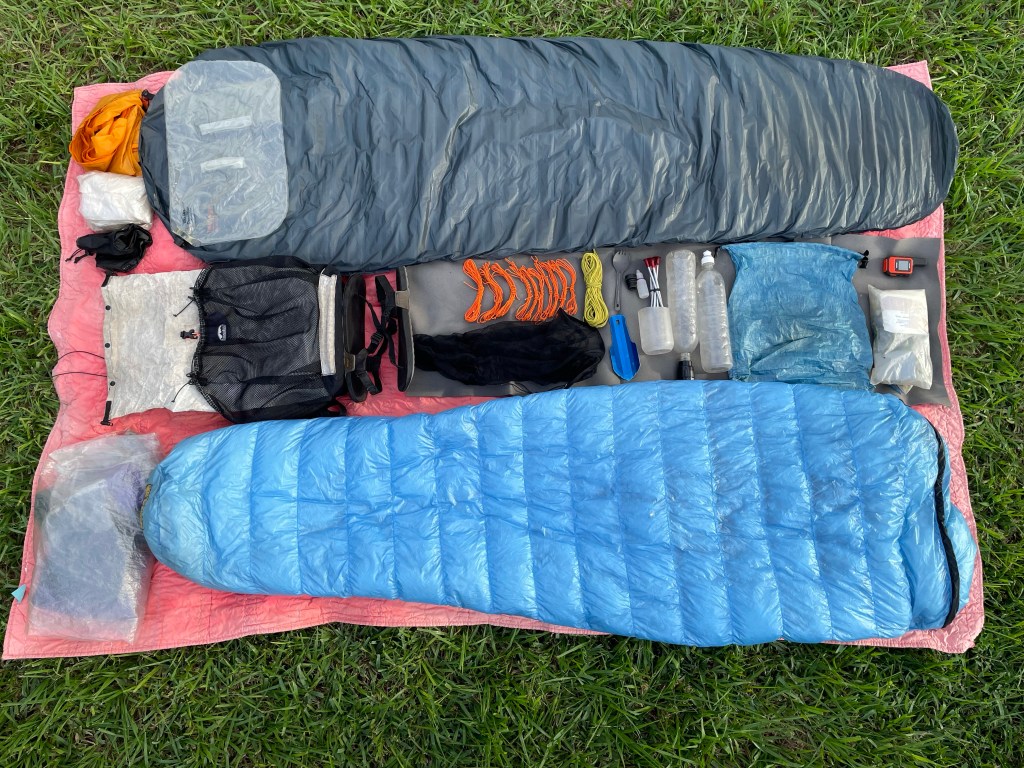
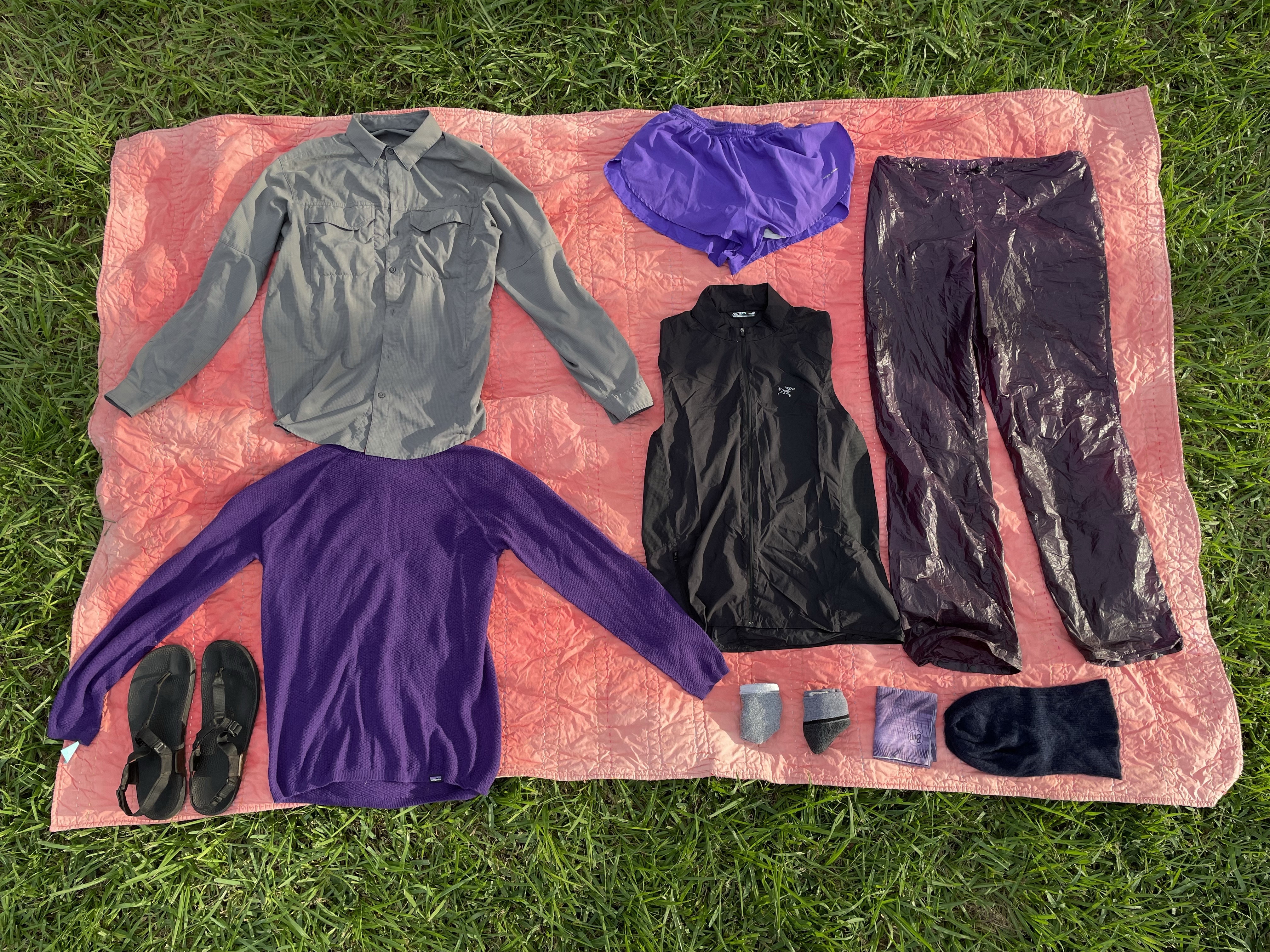

I’ve re-weighed all my gear at the terminus of my hike. This is the exact set of gear I carried from Rangely, Maine to Mt. Katahdin (the last ~200 miles). Generally, this was the set up I used from Pearisburg, Virginia onward, however, I did send home a few final items in Rangely.
At the beginning of my hike, my base weight (excludes worn weight and consumables) was 10 pounds, 12 ounces. You can read more about how I thought about gear when I began my thru hike at this blog post, and the Lighterpack that details my set up starting can be found here.
At the end of my hike, my base weight is 6 pounds, 6 ounces (!). I am mega stoked on this outcome, but there are a few caveats that must be noted that make it really more like 7 pounds even (but I’m totally leaving the lower figure above in bold):
- This set up is not one that I would have been able to use for the entire trip. I would have frozen to death in the first six weeks, or at least experienced serious hypothermia. I am comfortable, however, taking this set up down to about 35 degrees overnight. With the addition of a fleece or a puffy jacket, this could probably be at freezing overnight. In any case, I’m pretty excited with it, because most of the year in the Southeast falls in a comfortable range that this would be a useful set up.
- When I chose to send my hipbelt home, I no longer had quick access hipbelt pouches to store my most frequently used items. For this reason, I began carrying my phone and headphones in the breast pockets of my shirt (total weight ~9 ounces). By definition, this makes these things worn weight rather than base weight, but I think this is a stupid distinction.
- There is one area where this set up is lacking, even in the warmer temperatures, and that is in bug protection. I only used my bug bivy (weight ~7 ounces) a handful of times in Massachusetts, and had been waffling on whether or not to send it home for some time. I’d grown confident enough in my tarp pitching ability that the splash protection wasn’t a requirement any longer. I decided to send it home, and paid the price in Maine. Particularly in the low altitude portions of the 100 mile wilderness, I got absolutely roasted by all manner of insects at night. I used my quilt and headnet as best I could, but it was not adequate. If I knew I would be camping away from water, at high altitudes, or in temperatures where bug pressure was unlikely to be a major issue, I’d probably be OK to leave it at home.
The Lighterpack for my final set up can be found here. Additionally, the components of weight break out as shown graphically below:

I considered thorough gear reviews of each and every item that had any part in my adventure, but ultimately decided (for now) this blog isn’t a gear review site. Instead, I thought it would be interesting to walk through each category, and explain what changed and why.
- Clothing / Worn Weight
- Leggings were no longer required from mid-May onward (probably could have done without sooner, that’s just when my parents came to visit)
- I traded out my wool buff for a lighter, UV / Insectshield version in mid-May
- It was no longer necessary to carry two full pairs of tall socks. In Franklin, North Carolina, I picked up a pair of Injinji sock liners that I’d carry the rest of the trip. Their purpose, however, changed from extra warmth, to being backup / sleep socks
- Gloves were no longer necessary from Damascus onward (the aforementioned sleep socks would work as gloves in a pinch)
- My puffy jacket went home in mid-May. I picked up a wind vest when I sent the puffy home. I think I could have sent the puffy home sooner if I had this vest, the vest + base layer combination is shockingly warm and versatile
- I lost my original hat in Virginia, and replaced it with a similar hat
- Sleep System
- In Pearisburg, Virginia, I traded out my 20 degree Enlightened Equipment Revelation quilt for a 38 degree Western Mountaineering Nanolite quilt.
- I had high hopes for the Uberlite sleeping pad, and frankly, it does exactly what it says it will do. It is not, however, sufficiently insulated for true 3-season backpacking use. From the Nantahala Outdoor Center to Damascus, Virginia, I carried a cut-down-to-torso-length Nemo Switchback. Unfortunately, because I cut it down in the field, I don’t know what impact this had to my base weight, but it is worth noting, because for that stretch, my pack was at its heaviest (somewhere between 10 pounds, 12 ounces and 11 pounds, 9 ounces, since the full length Switchback is quoted at 13 ounces in weight). So, during this stretch, I’d have my 1/8″ foam pad under the Nemo pad under the Uberlite under me. It was a princess and the pea type situation, and kept me warm when nighttime temperatures dropped to single digits.
- Entertainment
- Once I got good enough at hiking that I could hike for entire days, I found myself pulling out my cards and harmonica less and less. By the time I sent them home, I hadn’t used either in over a month.
- Eyewear
- I don’t really need glasses that badly. I wear them because if I don’t, I’ve historically gotten pretty severe headaches. As it turns out, the cause of this has more to do with looking at a computer screen all day than it does whatever steps my brain is taking to “filter out” my bad eye. The decision to send my eye glasses home (but keep my sunglasses) meant I could also send home their carrying case, since my sunglasses live around my neck during the day when not in use.
- I also accidentally sent home the microfiber cloth I brought to clean the lenses of my sunglasses, since it was in the case with my eyeglasses. This was a mistake that I regretted every time I tried to clean my sunglasses with my greasy fingers and sweaty buff.
- Food Storage / Preparation
- Throughout the hike, I found myself cold soaking less and less, and instead opting for food that was ready to eat when I was resupplying. At the beginning of the hike, I was cold soaking breakfast (oatmeal) and dinner (ramen bombs) on a daily basis. Let’s not mince words here – cold soaking is nearly as much of a hassle as cooking food (assuming “cooking” here really just means boiling water and adding it to dehydrated food), with substantially less reward. At some point, I grew tired of trying to keep my jar clean, waiting for things to soak when I’d forgotten to start the dinner soak during my afternoon snack, and finding a good place for my cold soaking jar to live. So I got rid of it, and didn’t look back.
- Cold soaking / no prep for the entirety of my thru hike is a decision I do not regret. I would consider carrying a stove for the first six weeks or so if I was going to do it again. Looking forward to future trips, that will inevitably be shorter than the AT, I’ll be carrying much more interesting food, and likely a stove.
- I also ditched the carabiner that came with my bear bag when it broke. Knots are superior to micro-biners from a weight and simplicity perspective for anything that isn’t time sensitive (this attitude got me in trouble a couple times trying to undo a bowline in the rain to get my food back down from a tree, but so it goes).
- Shelter / Rain Protection
- No more trekking poles! The Gossamer Gear LT5 trekking poles are among the lightest you can buy, and with that, there are some durability issues. The fact is, I didn’t meet a single thru hiker with these poles that didn’t have to repair or replace them at least once. This is a bummer, because I love Gossamer Gear, but frankly, these poles just don’t cut the mustard. By Vermont, mine had begun to no longer stay extended – if you put even 25% of your body weight on one, it would collapse, and you would fall. Further, carbide tips aren’t super useful over rock (which is 70% of New Hampshire and Maine). I stowed my poles for significant sections of the Whites, and frankly, never looked back. This meant pitching my tarp required the use of one or more trees, or small sticks that I’d find around camp. I do not know if I will carry trekking poles on future trips (although I probably should, Gossamer Gear sent me a new pair of LT5s for free).
- I quickly realized I did not need one of the stakes I’d brought. I could definitely cut down further here, making use of natural anchors (trees, rocks, branches), and using my trowel and / or spork as stakes are all options. There were a couple nights where I even used sticks stuck in the ground in place of stakes!
- As mentioned above, I sent my bug bivy home, which turned out to be a poor decision.
- Laundry / Bathing / Bathroom
- I left my dedicated bidet bottle in the back of Bobby the Greek’s truck in Franklin, North Carolina. Necessity made me get comfortable with using my dirty water bottle for this purpose.
- Water Storage / Treatment
- A hiker named Sky challenged me to try out the Sawyer Micro Squeeze when I froze my full size Squeeze going over the Roan Highlands. He cautioned me, however, to be prepared to replace it every six to eight weeks. He was right on the money on both accounts. The weight savings aren’t that significant, but the Micro Squeeze is significantly smaller.
- I stopped using water bottle holders on the front of my backpack, in favor of storing them in the traditional location of the side pockets. I would rethink this if I was on a trail with less available drinking water than the AT. By the end of the trail, I rarely carried more than a half liter of water from one water source to the next (so the weight distribution advantage of carrying water on the front was greatly diminished). Further, I rarely drank water between water sources, opting for a water management strategy known as “cameling”, wherein one drinks large quantities at water sources and carries less. Finally, the poncho was so much easier to navigate with water bottles stowed behind me instead of poking out like oddly shaped breasts under my rain gear.
- Hygiene / First Aid
- No changes here, but I’ll note I did not ultimately use the following items (but would still carry them if I had a do-over):
- Sunscreen
- Lip balm
- Bug spray
- Any of the pills in the pill bag (NSAID, anti-diarrheal, and allergy medicine)
- No changes here, but I’ll note I did not ultimately use the following items (but would still carry them if I had a do-over):
- Technology
- In Monson, Maine, Poet (co-owner of Shaw’s Hiker Hostel and Poet’s Gear Emporium) offered me a solution to a problem I’d faced the entirety of the AT: my Garmin GPS was constantly swinging around on the carabiner that came with it. I removed the mounting hardware and replaced it with some knotted shock cord.
- I switched out power banks to the lighter, smaller Nightcore NB-10000, at no reduction in capacity.
- I switched out my wall adapter in favor of the Anker Nano. I lost one USB port in the process, but discovered pretty early on that two really wasn’t necessary for me, my frequency of rest days, and my electronics usage.
- I switched up my cable system to include one USB-C to USB-C and a series of adapter tips. This worked well for a while, until one of the adapters broke. You can’t find these adapter tips super easily in physical stores, so I ended up having to pick up an Apple charging cable that I carried from Gorham, New Hampshire to Katahdin. I’ve since replaced it with a new adapter and a second USB-C to USB-C cable.
- Tools / Repair
- I sent home my knife, as I never used it (mini scissors are better for most tasks).
- I added a piece of sponge in Franklin, North Carolina that I harvested from a hiker box. This tiny piece of coarse material would do all my cleaning for nearly 2,100 miles.
- Backpack
- In Pearisburg, Virginia, I switched from the Gossamer Gear Gorilla to the Zimmerbuilt Quickstep (with some modifications to fit my needs). The short story here is the backpack I started with had a lot of sentimental value, but was really overkill for the kit I was carrying. I do not recommend switching from framed to frameless in the middle of a thru hike, but if I did it, so can you. Hindsight 20/20, I should have familiarized myself with the intricacies of packing and carrying a frameless backpack before the trip began, and started with it. I’ll continue to use my Gorilla for trips where water or food scarcity requires my total carried weight to exceed ~25 pounds.
- I took a pretty gnarly fall in the Whites that was substantial enough to temporarily remove my hipbelt from my backpack (this is a part of the design, as the Quickstep isn’t really designed to have a hipbelt). I stood up, checked for wounds, clear. I rubbed my throbbing temples – I felt… strangely… comfortable? It took me a few seconds before I realized the hipbelt had been disconnected on one side. It was liberating! I’ve always been doubtful, but if you have a baseweight / setup that can fit in a frameless pack, you may find it more comfortable to carry without a hipbelt. The hipbelt was keeping the pack from being able to move with my body, and long-term, was restricting my range of motion.
So there you have it. Any questions? You know where to find me.
Cheers,
Billy
 Billy Goes Hiking
You should contact some of the companies who you used for advertising. We all can use extra income streams.
LikeLike